FiveM HWID Spoofer: What It Beats, What Still Catches It
A FiveM HWID spoofer defeats one identifier, not a whole profile. What spoofing really beats, what still catches the evader, and what owners should do.

Roby Einstein
FairShieldAC Security Team
A FiveM HWID spoofer changes what one client reports about itself. That beats a ban stored as a single value. It does not beat a profile built from several. If someone you banned walked back in last week, the likely cause is not that hardware bans are useless - it is that the ban was pinned to one identifier.
Written for server owners. If you came looking for a spoofer, this page has nothing for you: no tool names, no mechanics, no steps.
What a FiveM HWID spoofer actually changes
Treat the spoofer as a black box: it runs on the client and changes what that client reports. What matters is what it reports against. Hardware identification on FiveM runs on tokens, and the official reference is blunt - "Gets a player's token. Tokens can be used to enhance banning logic, however are specific to a server." (GET_PLAYER_TOKEN) Asked how txAdmin obtains HWID, a Cfx.re contributor pointed at that native (thread 5292596).
On a forum request to expose raw HWID as a player identifier, a long-standing Cfx.re contributor answered that it "would be way easier to spoof and way less 'true' than any of the current 3PIDs, since they're self-reported rather than verified through a trusted third party" (thread 833861). Account identifiers are attested by a third party; hardware signals are reported by the machine you do not control. Hardware is harder to change than a free account signup, but harder still has a price. This page is about what defeats those bans; for how the bans themselves are built and stored, see how HWID bans work.
Why one identifier is never proof of identity
txAdmin's ban settings carry the warning, under the option Required Ban HWID Matches: "Since Hardware ID Tokens are not guaranteed to be unique, there is the possibility of tokens from two players matching without them being related to each other." The same panel adds: "Note: Most players have 3 to 6 HWID tokens." (txAdmin ban settings)
In a Cfx.re thread titled "Banning Player Tokens, duplicated tokens across multiple players", an owner describes banning two players, finding two further, unrelated players on the exact same token - four accounts on one value - then watching one ban removal let those two back in (thread 5296645).
One matched token is worth a staff look; matches across several identifier types are evidence. When a collision hits an innocent player, false positives and fair appeals covers the recovery path.
Why multi-identifier correlation beats any single value
The official identifier reference lists what a server sees on connect: steam, discord, license, license2, fivem and ip, noting that license2 is the ROS license for Steam users and can hold the same value as license (GetPlayerIdentifiers). txAdmin validates a wider set, including live and xbl (txAdmin constants).
- license and license2 - Rockstar hashes, attested by a third party. Anchor every ban here.
- steam, discord, fivem, live, xbl - platform accounts. Store all of them, not just what your panel shows.
- ip - weakest alone. An owner in the ban-evasion thread: "IPs are mostly dynamic nowadays so it's pointless".
- HWID tokens - plural and self-reported, 3 to 6 per player by txAdmin's count.
Correlation wins because matching is set-based. In txAdmin's ban lookup a ban fires if any single stored identifier matches, while the hardware side fires once enough tokens match; either path alone blocks the join (txAdmin ban lookup). You are not banning a HWID. You are banning a set.
txAdmin even tells the blocked player how it caught them: "Note: the ban above was applied for another license, which means some of your IDs/HWIDs match the ones associated with that ban" (locale strings). Enforce at playerConnecting with deferrals (FiveM docs).
FiveM HWID spoofer detection: what a returning cheater looks like in your logs
There is no detection event called "spoofer". What you get is a pattern across records you already hold.
- A new account showing behavioural and social overlap with a removed account.
- A partial identifier overlap: fresh accounts, something in the connect payload matching a ban record.
- The same cheat class back on the same resource days after a ban.
- Repeat join attempts that stop when a ban record is revoked.
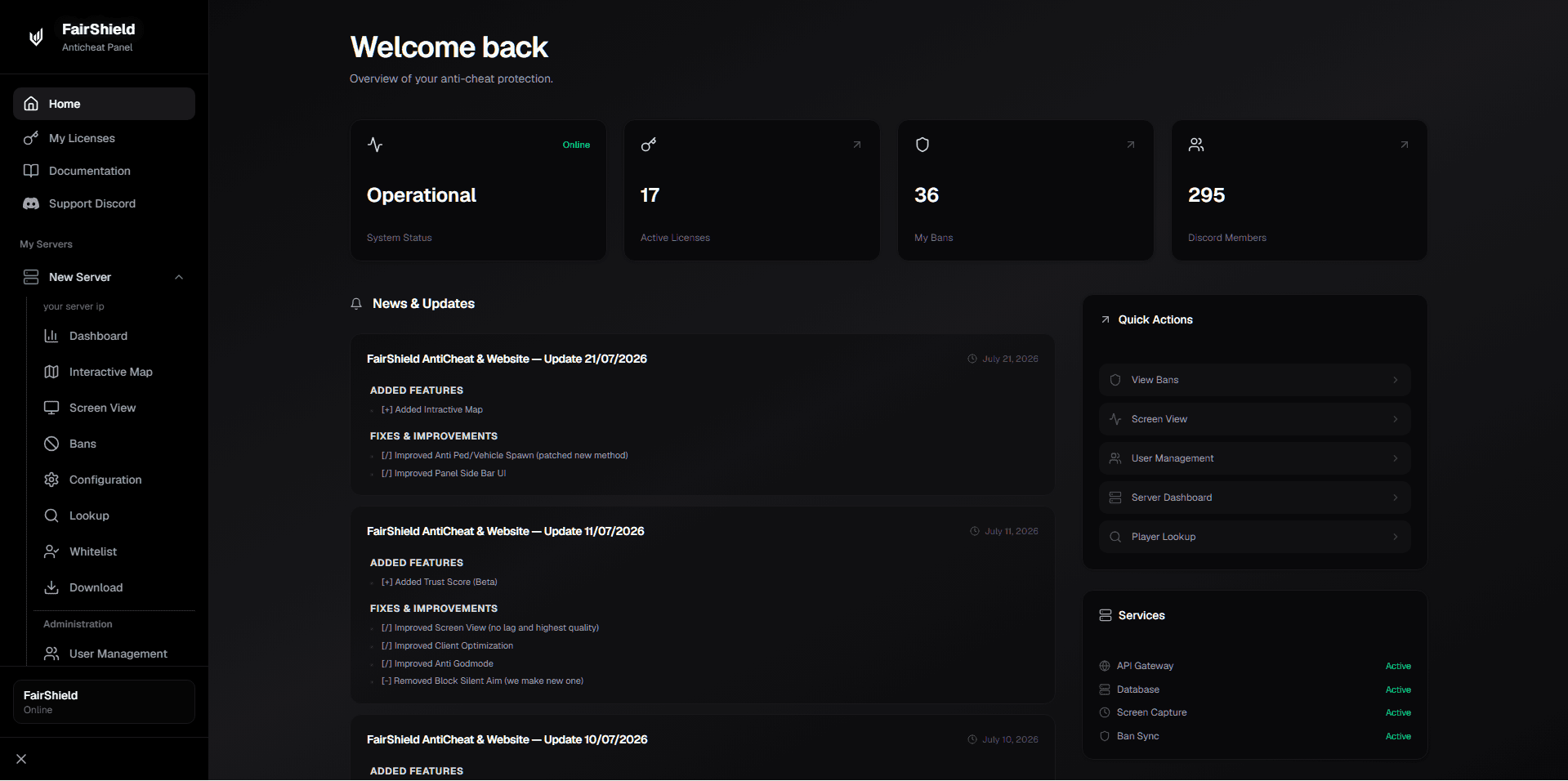
Flag these; do not auto-ban. A partial match belongs in the queue you use for a cheater report, weighed by a human. FairShieldAC includes Members Lookup as a manual admin pre-screen tool for that call.
Evasion attempts and what still catches them
Read this as a checklist of your own configuration.
| Evasion attempt | What it defeats | What still catches it | What you should do |
|---|---|---|---|
| New Steam or Discord account | A ban stored against that one account ID | The Rockstar license, the hardware tokens already on the ban, and logged behaviour | Store every identifier the connect event gives you on every ban, not just the one your panel shows |
| New IP address, or a VPN | An IP-only ban, which dynamic addressing already made unreliable | Account identifiers and hardware tokens, none of which an address change touches | Never ban on IP alone; treat an address as one weak signal inside a set |
| Fresh operating system install | Anything you recorded only in a local profile or a client-side file | Third-party attested account identifiers, which live outside that machine entirely | Anchor bans to license and platform accounts first, hardware second |
| Client-side spoofing of reported hardware | A ban keyed to a single stored hardware value | The rest of the correlation set, plus the fact that a ban commonly carries several tokens | Leave Required Ban HWID Matches at the shipped default and widen what each ban records |
| Borrowed, shared or purchased account | Your assumption that one account equals one person | Behavioural analysis on the live session, and hardware tokens if the same machine returns | Judge the session in front of you rather than the account age, and log evidence on every action |
| Residual risk: no prior identifier present | Identifier-based enforcement generally, as with any anti-cheat | Live behavioural detection on the session itself, which does not depend on history | Spend on detection quality and a role-gated allowlist rather than more identifier columns |
Why a cross-server ban network raises the cost of evasion
Start with the platform constraint; getting it wrong discredits the rest. FiveM's player tokens are "specific to a server", and txAdmin's ban database is per-server - the docs call it a "Self-contained player database" (txAdmin docs). Stock bans do not travel between servers.
What travels is the account layer, plus whatever a shared FiveM anticheat carries itself. A cross-server network raises evasion cost because it correlates attested account identifiers across participating servers, and because a shared network sees the same connection across every server that runs it. FairShieldAC runs that kind of network: HWID and cross-server bans screened at connect on HWID, IP, Steam and Discord. One server costs an evader one fresh identity; a network costs one per server. The best FiveM anticheat options compared lays out the field.
Should you set Required Ban HWID Matches to 1 or higher?
txAdmin describes it in its own words: "This option configures how many HWID tokens must match between a player and an existing ban for the player join to be blocked, or can disable HWID Bans entirely." That wording, and the "recommended" label behind the advanced toggle under Settings, Bans, come from the panel itself (txAdmin ban settings); the shipped default is 1 (banlist schema).
Leave it where it ships. Raising the threshold trades enforcement strength for collision safety, worth doing only with a documented collision in front of you. If you change it, record the date, the reason and when you will revert (txAdmin settings walkthrough).
One caveat: hardware data is not guaranteed to be present. txAdmin's event docs say the banned hardware identifiers "Might be an empty array" (txAdmin events). A ban can exist with zero tokens attached, which is why the account layer carries the weight.
The honest limit: new hardware beats any hardware-based ban
No vendor page wants to print this, so here it is. Identifier matching can only act on identifiers it has seen before. That ceiling applies to every hardware-based ban, FairShieldAC's included, which is why detection quality carries the weight.
A ban is only as good as the FiveM anti cheat detection behind it, and detection is the part an evader cannot reinstall around. If the same person returns clean, nothing in your ban list helps; what helps is flagging the behaviour fast and banning again. That is why how a FiveM anticheat actually detects a cheater matters more than your ban table's column count. The FiveM security docs put it plainly: "The anti-cheat team is always trying to improve the anti-cheat, but sometimes things slip through." (Secure Your Events)
The lever for raising cost is the allowlist. txAdmin ships six modes, defaulting to disabled (allowlist schema). A contributor in the Cfx.re ban-evasion thread draws the useful distinction: gate on a specific Discord role, not mere membership, "because it's easy to change your IP, create a new discord account & join" (thread 5300462). A role gated behind an application costs an evader what a fresh account cannot buy.
Frequently asked questions
Can a HWID spoofer get a banned player back onto my FiveM server?
Sometimes, and it depends on how thin your ban record is. A ban stored against one hardware value is the easiest to walk past. A ban carrying license, license2, Steam, Discord and the full token set requires all of them to have been replaced. Widen what each ban stores and the same tool stops being enough.
Why did two unrelated players get caught by the same HWID ban?
Because hardware tokens are not unique. txAdmin's ban settings state it directly: "Since Hardware ID Tokens are not guaranteed to be unique, there is the possibility of tokens from two players matching without them being related to each other." A server owner on the Cfx.re forums documented four accounts sharing one token; lifting one ban restored access for two unconnected players. A single token match should flag a player for review, never auto-ban one.
Why do some banned players come back after changing their PC?
Expect a reinstall to affect hardware-derived signals and to leave attested account identifiers untouched, because the Rockstar license, Steam and Discord do not live on the machine. Hardware signals are the perishable layer of any ban; the durable layers are attested account identifiers and live detection on the session in front of you.
How do I tell a returning banned player from a genuinely new one?
Correlate rather than match. Compare hardware tokens, IP, Steam and Discord against your ban records, then weigh those against behaviour: session timing, the resources they probe, the names they use. A single overlap is a flag; several across categories make a case. Send it to a human with the evidence attached, and record the reasoning so an appeal can be answered honestly.
The next step on your own server
Open a ban you know was evaded and count the identifiers on it. If the answer is one, that is your problem. Widen what every ban records, leave Required Ban HWID Matches at its default, route partial matches to a person, and gate your allowlist on a role. FairShieldAC screens HWID, IP, Steam and Discord against a global ban network on every plan, free trial included; see plans. What a FiveM anti cheat actually detects covers the layer behind any ban, the best FiveM anticheat options compared covers choosing one, and VPN blocking is the companion piece.