Best FiveM Anti Cheat in 2026: 5 Solutions Tested & Compared
Which FiveM anti cheat actually stops mod menus and aimbot in 2026? We tested client-side vs server-side detection, HWID bans, and pricing.

Roby Einstein
FairShieldAC Security Team
TL;DR
The best FiveM anti cheat is the one that catches a cheat on the player's machine, not just after the damage shows up on the server. In our testing, hybrid client + server-side detection caught mod menus that server-only tools missed entirely, and HWID bans kept them out where IP bans failed. FairShieldAC is the option built around both, with the trade-off that it costs more than a basic Tebex script.
Why your FiveM server needs an anti-cheat
On a public server, cheaters aren't an "if," they're a "when." Picture it: you're 40 minutes into a roleplay scene and someone with a mod menu godmodes through the middle of it. Twenty people just watched their session get ruined, three of them log off, and your staff spends the night in ban-appeal threads instead of running events.
That's the real cost of going unprotected: not the cheat itself, but the players it drives away. A good anti-cheat doesn't just clean up afterward. It stops the cheater from joining, catches them in real time if they get in, and hands you proof when you ban.
What separates a good FiveM anti cheat from a weak one
Before naming names, here's what actually matters when you compare options:
- Detection method. Signature-only detection breaks the moment a cheat updates. Heuristic detection flags behavior, so it survives updates. Hybrid (both) is the strongest.
- Client-side vs server-only. Server-only tools are blind to Lua executors, memory manipulation, and client-side aimbots, because those never touch the server directly.
- Performance. Published tick-latency numbers are the only honest way to compare impact. "No lag" without a figure means nothing.
- Ban enforcement. IP bans are beaten with a free VPN. HWID bans tie the ban to the machine.
- Evidence. Screenshots and PC verification turn a ban from "trust me" into proof.
- Update cadence. Cheat sellers ship updates constantly; a tool that updates weekly leaves a window open.
How we tested
We evaluated each option against those six criteria using vendor documentation, CFX.re community feedback, and hands-on testing on a 64-slot QBCore server running 35 resources, with tick impact measured in `resmon` during live play.
The main types of FiveM anti cheat, compared
Most FiveM anti cheats sold on Tebex or shared on the CFX.re forums fall into four approaches. The category tells you more than any brand name, because the limitations below come from the *architecture*, not the logo.
1. Server-side signature scripts
Reactive by design. These keep a database of known cheat signatures and match against it, so a freshly updated cheat sails through until the database is refreshed, often days later. With no client-side component, they can't see a Lua executor or memory edit that never broadcasts to the server. Fine as a supplement; risky as your only line of defense.
2. Community-updated anti-cheats
More popular and more user-friendly, often with Discord webhooks and a ban dashboard. But the detection rules are community-maintained, so every hour between a new cheat dropping and a volunteer writing the rule is an hour of exposure. Still server-side only, and without HWID enforcement a banned player simply rejoins on a VPN.
3. Budget paid scripts
The middle tier: cheap, and adequate for a small private server, but they cover only a subset of common menus and rarely keep pace with cheat updates. Not enough for a public community where reputation is on the line.
4. Free Tebex scripts
Zero cost, and they share one fatal trait: server-side only, signature-dependent, and a single point of failure. Useful for testing, not for protecting a live community.
5. FairShieldAC: hybrid detection
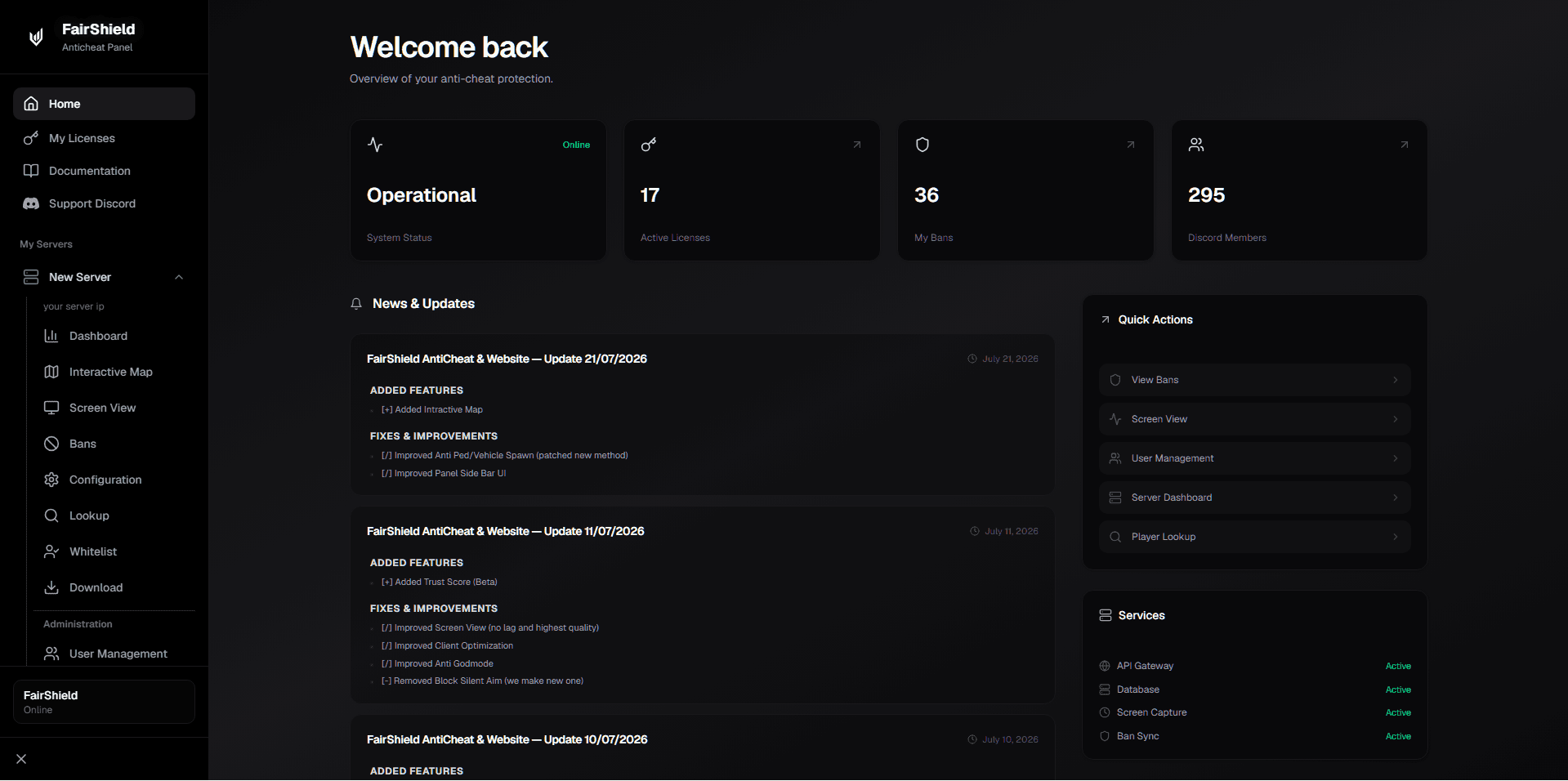
This is the layer the others skip. The client-side component watches running processes, injected DLLs, and Lua execution the moment a tool touches the game; the server-side component simultaneously flags impossible behavior (instant aim snaps, teleport jumps, wallhack-style targeting). Either side can trigger a ban, and both capture screenshot evidence. On top of that sit two more layers (how the three-layer model works): Members Lookup pre-screens players against a global ban list before they connect, and an on-demand PC Scanner verifies suspicious-but-inconclusive cases.
FairShieldAC reports 0.01-0.04ms tick latency and daily detection updates.
Side-by-side comparison
| Feature | Signature scripts | Community AC | Budget / free | FairShieldAC |
|---|---|---|---|---|
| Detection method | Signature only | Signature only | Signature / varies | Hybrid + heuristic |
| Client-side detection | ❌ | ❌ | ❌ | ✅ |
| Performance impact | Not published | Not published | Varies | 0.01-0.04ms |
| Ban enforcement | IP only | IP + ID | IP / varies | HWID + IP + ID |
| Global ban network | ❌ | ❌ | ❌ | ✅ |
| Screenshot evidence | ❌ | ❌ | ❌ | ✅ (OCR) |
| Update cadence | Manual | Community | Manual | Daily |
| Starting price | ~$15/mo | ~$20/mo | $5-50 | $29.90/mo |
Client-side vs server-side: why it decides everything
A server-only anti-cheat can only judge cheats by the events the server receives, so with a silent-aim cheat, it sees a suspicious headshot and has to *guess* whether the angle, timing, and hit rate add up to aimbot. Cheat authors have spent years tuning silent aim to look human, which is exactly why server-side guessing misses.
A client-side anti-cheat doesn't guess. It sees the aimbot process running next to the game, the memory writes overriding the aim vector, the cheat DLL injected into FiveM. No ambiguity, which is why hybrid detection catches what server-only tools wave through.
HWID bans and the global ban network
An HWID ban ties enforcement to the machine's hardware instead of an IP address, and that difference is everything. An IP ban is beaten with one click of a free VPN (many menus even rotate IPs for you); an account ban, with a new account. Beating an HWID ban means swapping hardware or running a spoofer.
FairShieldAC extends that with a shared ban network: when a cheater is banned on one protected server, their HWID propagates to every server in the network, so they can't just hop to the next community. As the network grows, getting caught once means getting locked out everywhere.
Pricing, and the honest trade-off
| Product | Monthly | Best for |
|---|---|---|
| Free scripts | $5-50 | Test servers |
| Budget script | ~$10/mo | Small hobby servers |
| Signature script | ~$15/mo | Small communities |
| Community AC | ~$20/mo | Growing servers |
| FairShieldAC Monthly | $29.90/mo | Serious communities |
| FairShieldAC 3 Months | $79.90 | Growing servers |
| FairShieldAC Annual | $249.90 | Multi-server networks |
The honest trade-off: FairShieldAC is *not* the cheapest option. If you run a small private server with trusted regulars, a $10 script may genuinely be enough. The case for paying more is coverage and enforcement that stick: client-side detection and HWID bans that a determined cheater can't shrug off. For a public community whose reputation depends on staying clean, that's usually worth the difference.
Verdict
For a private test server, a free script or a budget option can do the job. For any server that cares about its players and its reputation, the best FiveM anti cheat is the one with client-side detection, HWID enforcement, and layered protection: the difference between "catches most cheats eventually" and "catches them the moment they load." FairShieldAC is designed around exactly that difference.
Related reading
- Why one anti-cheat isn't enough: the three-layer model
- FairShield Gravity: DDoS protection for FiveM servers
- Detection changelog: how often coverage updates
FAQ
What is the best FiveM anti cheat?
The strongest option is one with hybrid client- and server-side detection plus HWID ban enforcement, because it catches cheats on the player's machine and keeps banned players out. FairShieldAC is built this way; most competitors are server-side only.
Do I need client-side anti cheat for FiveM?
For a public server, yes. Server-side-only tools can't see Lua executors, memory manipulation, or client-side aimbots, since those never announce themselves to the server. Client-side detection is the only way to catch them before they affect play.
How much does a FiveM anti cheat cost?
Roughly $5-50 for basic or one-time scripts, up to about $30-220/month for a full hybrid solution like FairShieldAC. The right number depends on whether you're protecting a hobby server or a public community.
Can any anti cheat detect every mod menu?
No tool catches 100%. Hybrid detection that combines known signatures with behavioral heuristics catches the most, including novel cheats without a known signature, but treat any "100% detection" claim as a red flag.