FiveM Anti Cheat: What It Is and How Detection Works
What a FiveM anti cheat is, the cheat categories it faces, how behavioural and signature detection actually work, and what happens after a player is flagged.

Roby Einstein
FairShieldAC Security Team
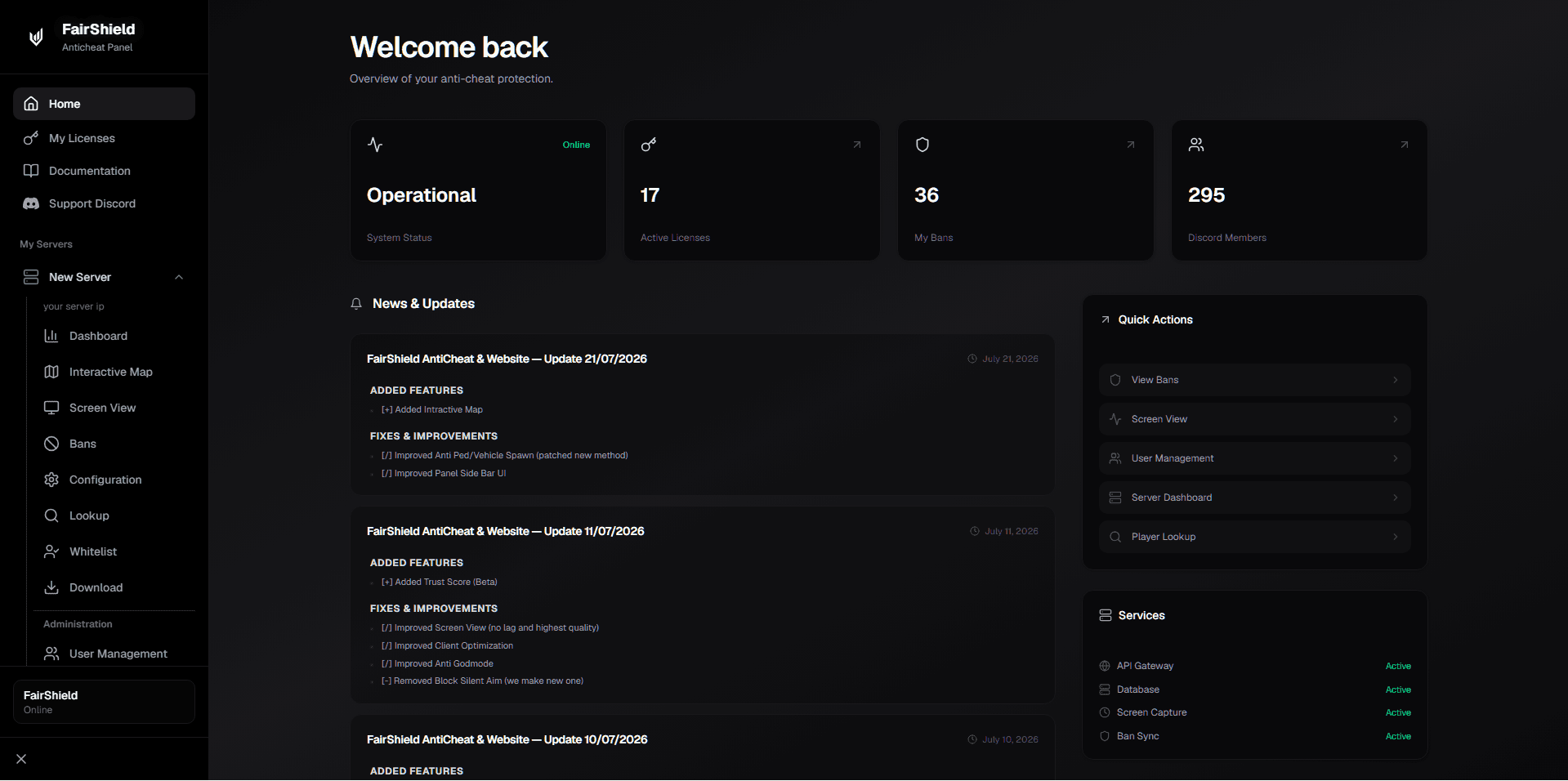
A FiveM anti cheat is a server resource that watches both the connected game client and the server itself for the signs of cheating software, then blocks the action and bans the account behind it. It is not one check but several layers: code on each client looking for injected executors and tampered memory, and code on the server looking for actions no legitimate player could produce.
This guide covers what those layers actually do, how a detection decision gets made, and what happens after a player is flagged. It is written for owners setting up protection for the first time, not for people already comparing vendors.
What a FiveM anti cheat is
FiveM servers run Lua and JavaScript resources on top of GTA V. That openness is what makes custom roleplay possible, and it is also exactly what cheat developers target. An anti-cheat installs like any other resource, but its job is to observe and enforce rather than add gameplay.
Two things in that description matter. First, an anti-cheat is a detection and enforcement system, not a network firewall. It does not stop attacks aimed at your host; that is a separate problem solved by DDoS mitigation. Second, it is software you run and control. Base FiveM ships with some platform-level protections, but nothing that recognises aimbot behaviour or a mod menu injecting into your resources.
The categories of cheat a FiveM anticheat faces
Cheats fall into a small number of families, and the family determines how detection has to work.
- Lua executors and code injection: tools that load arbitrary script into the client and call your resource functions directly.
- Mod menus: packaged cheat suites with a UI. The publicly known ones we test against include Eulen, Susano, Ghost, TZX, Keyser and Macho.
- Combat cheats: aimbot, silent aim, ESP, wallhack, godmode.
- Movement cheats: teleport, noclip, freecam, speed hack.
- Server-side exploits: vehicle spawn abuse, explosion spam, and malicious or spoofed event triggers.
Most players who get caught are not running anything exotic. They bought a mod menu, and the menu bundles several of the categories above behind one keybind.
| Cheat category | What it does in game | How it is detected |
|---|---|---|
| Lua executor / injection | Loads unauthorised script into the client and calls resource functions directly | Client-side integrity checks on the script environment, plus unexpected calls at the server boundary |
| Mod menu | Bundles combat, movement and spawning cheats behind one interface | Behavioural detection of what the menu does, plus client-side checks against the menu itself |
| Aimbot / silent aim | Snaps or redirects shots onto a target | Server-side analysis of aim movement and hit patterns over time |
| ESP / wallhack | Draws players and objects through geometry | Client-side detection only; rendering produces no server signal |
| Godmode | Ignores or reverses applied damage | Server-side comparison of dealt damage against reported health |
| Teleport / noclip / speed | Moves the ped beyond what the physics allow | Server-side position and velocity tracking between ticks |
| Vehicle spawn / explosion spam | Floods the session with entities or explosions | Server-side rate and origin checks on entity creation and explosion events |
| Event spoofing | Calls your server events with forged arguments | Encrypted and shuffled event triggers, so a hand-built call does not match |
How FiveM anti cheat detection actually works
Signature matching finds tools it already knows
Signature matching looks for something identifiable about a specific cheat: a file, a pattern in memory, a recognisable name in the script environment. It is cheap to run and produces few false positives, because a signature either matches or it does not.
The weakness is structural. A signature only catches what someone has already catalogued. When a mod menu ships an update, its footprint changes and that check goes blind until the signature is rewritten. This is the cycle every signature-only product lives in, and it is why detection that survives cheat updates has to rest on something else.
Behavioural detection finds what the cheat does
Behavioural, or heuristic, detection ignores what the cheat is and measures what the player does. A ped that crosses more ground between two server ticks than any vehicle in the game could have covered has teleported, regardless of which tool moved it. Damage that never reduces a health value is godmode whether the menu is called Eulen or was written last night by someone in a Discord server.
That is why heuristic detection holds up across updates. A cheat author can rename files, repack, and obfuscate freely, but the in-game effect has to stay the same or the cheat stops being worth money.
The tradeoff is that behaviour needs interpretation. Your own scripts also teleport players, freeze them, and grant temporary invulnerability. A detection system that has no idea what your resources legitimately do will flag them, and that is where badly tuned anti-cheats produce false bans.
Why client-side and server-side are both required
Server-side detection is trustworthy because the server owns the data. It is also blind to anything that never reaches it. ESP is the clean example: a wallhack only changes what the cheater's screen draws, so the server sees a completely ordinary player standing still.
Client-side detection can see those things, but it runs on a machine the cheater controls, which means it can be attacked, faked, or unloaded.
Neither half is sufficient on its own. Server-side catches what a compromised client would never report honestly, and client-side catches what never produces a server signal at all. FairShieldAC runs hybrid heuristic detection on both sides for that reason, and adds a screenshot system with OCR verification so a flagged client can be checked visually instead of on telemetry alone.
A note on event spoofing
One category deserves separate mention because it is not really a client cheat. Every server event you register is an entry point. If a player can work out the event name and its arguments, they can call it directly from an executor and ask your server to hand over money, a vehicle, or an admin flag.
Renaming events does not fix this. FairShieldAC encrypts and shuffles event triggers so a call assembled by hand does not match what the server expects, which closes off the class of exploit that needs no combat cheat at all.
What happens after a detection
Detection is only half a working system. Enforcement decides whether the same person is back in your city an hour later under a new name.
A ban tied to a username alone stops nobody. Enforcement worth having binds to identifiers that survive a fresh account: HWID, IP, Steam and Discord. HWID is the strongest of the four because it targets the hardware rather than the account, and we cover how HWID bans stop repeat cheaters in more detail separately.
FairShieldAC also propagates bans across a global ban network. When one server on the network bans a cheater, that ban applies across every server on it, so a player burned elsewhere does not get a clean first offence on yours. Members Lookup lets staff check a player against that history at lookup.fairshieldac.com before they ever connect.
On the reporting side, detections surface in a real-time web dashboard, through Discord webhooks, and via txAdmin integration, so staff see the flag with context rather than a bare log line at 3am.
What a well-built FiveM anti cheat does not do
The failure modes are as instructive as the features.
- It does not ban on a single ambiguous signal. One impossible position reading can be packet loss. A pattern of them across a session is not.
- It does not have to cost you frames. FairShieldAC measures its own tick latency at 0.01ms to 0.06ms; that is our own measurement rather than an independent benchmark, so confirm it on your own server under real load before you trust it.
- It does not require you to rewrite your framework. If a product needs deep edits to every resource you own, the integration work is the real price.
- It does not leave staff without evidence. A ban you cannot explain to an appealing player is a ban you will eventually reverse.
- It does not claim to catch everything. A product that promises total coverage is describing marketing, not detection.
The honest limits
No anti-cheat catches everything, and any vendor that says otherwise is selling rather than explaining. Private cheats written for a single target, sold to a handful of people, and updated the same week they are detected are the hardest case in this space for everyone in it.
What good protection changes is the economics. A public menu that gets detected has to be rebuilt before it is worth buying again. Cheaters lose hardware access rather than a throwaway account. The cost of cheating on your server moves from a cheap subscription to sustained effort, and the number of players willing to spend that effort on a roleplay server is small.
One further distinction matters: an anti-cheat does not protect you from DDoS. Those attacks target your host and never touch game logic, which is why network mitigation sits as a separate layer.
Where to go from here
Install something, run it for a week, and read the logs before you issue a single ban. You want to know what your server's normal looks like, which of your own resources trip behavioural checks, and how often staff actually reach for the screenshot tool.
Once the mechanics make sense, the next question is which product fits your server, and that is a comparison rather than a definition. Our writeup of the FiveM anti cheat solutions tested and compared for 2026 walks through the options side by side, and FairShieldAC's plans are listed on the pricing section of the homepage.